Why your estimating and takeoff tools need to be on the same platform

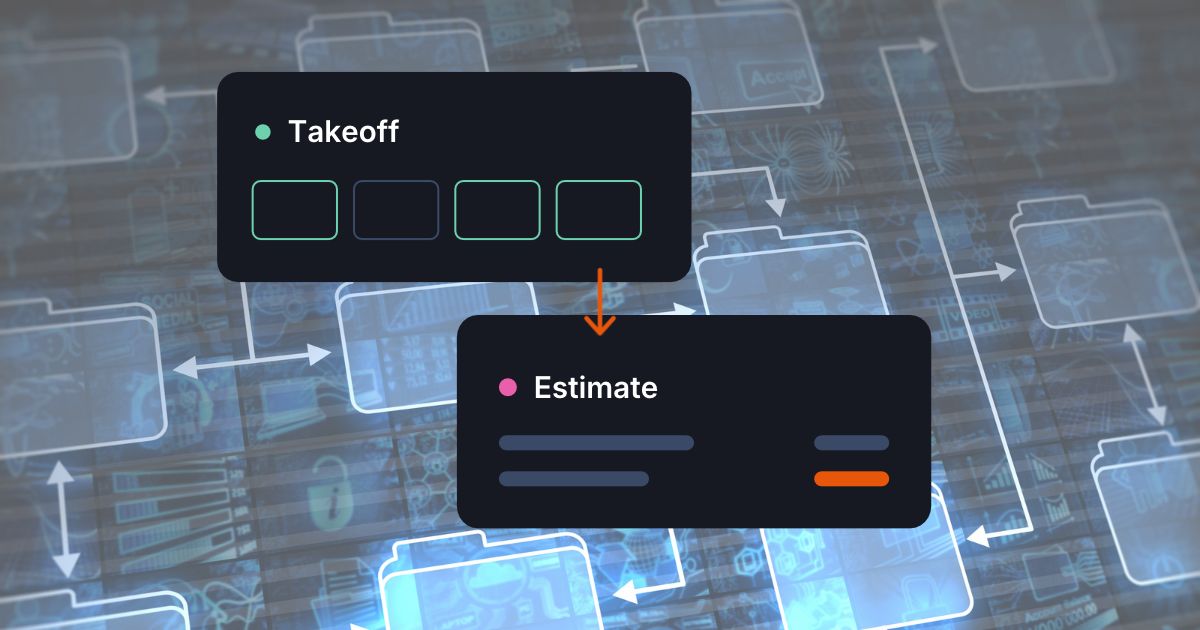
For many electrical and mechanical estimating teams, the biggest risk to a bid sits in the gap between tools. A takeoff is finished in one application, then exported, revised or copied into a spreadsheet or separate estimating package. Every time a drawing changes, both have to be updated again.
Each handover is a chance for a quantity to be missed, a formula to break or a revision to land in one file and not the other. Across a team handling dozens of bids a month, those small gaps add up to real bid risk.
Integrated takeoff and estimating software closes that gap. This article explains what an integrated platform is, the difference it makes to an estimating team, and why so many contractors still work across two tools.
What is integrated takeoff and estimating software?
Integrated takeoff and estimating software brings both stages of a bid into one platform. Quantities counted and measured on the drawings move straight into a priced estimate, with your labor, material and markup rates applied, without exporting, copying or re-entering data.
In a two-tool setup, the takeoff and the estimate are separate records. Someone has to move information between them and keep them in step as the project changes. In an integrated platform, the estimate is built directly from the takeoff, so there is one source of truth for every quantity on the bid.
What are the benefits of an integrated platform?
The benefits show up at team level: fewer errors, more consistent bids and more capacity to take on work without adding headcount.
A streamlined workflow
Takeoff and pricing happen in one place, in one sequence. Estimators don’t switch between applications, manage exports or reconcile two versions of the same job. The route from drawing to priced bid is shorter and easier to follow, both for the person doing it and for anyone checking it.
No manual calculations
When quantities are re-entered into a spreadsheet, the totals depend on formulas someone built, copied and adjusted over time. One broken cell reference can carry through an entire estimate unnoticed. An integrated platform applies your pricing to counted quantities directly, so the arithmetic is consistent on every bid.
No handovers
In many teams, one person completes the takeoff and another prices it. Every handover needs context: what was included, what was excluded, which drawing revision was used. With both stages on one platform, that context stays with the data, and anyone on the team can pick up the job where it was left.
Reduced costs
Two tools usually means two subscriptions, two sets of training and two systems to support. The larger cost is the time spent moving and checking data instead of estimating. Bringing the workflow together reduces both, and frees capacity to bid on more work with the same team.

Minimized duplication of revisions
Drawing revisions are part of every project. In a split setup, each revision means updating the takeoff, then updating the estimate to match, and hoping nothing is missed in between. On one platform, revisions are handled once, in one place, instead of being reworked across two files.
No data gaps
Every export or copy-and-paste is a point where something can drop out: a missed item, a layer that didn’t come across, a quantity pasted into the wrong row. Keeping takeoff and estimate together removes those transfer points, so what was counted is what gets priced.
One process
When every estimator works with their own combination of tools and templates, bids vary depending on who prepared them. A single platform gives the team one consistent way of estimating. Bids are easier to review, new starters get up to speed faster and results are more predictable.
Connected data
With takeoff and estimate in one place, every price can be traced back to the drawing it came from. Managers can see how a number was reached, check it against the drawings and challenge it before the bid goes out. That visibility is what gives the business confidence in the numbers it submits.
Why do estimators and contractors use two tools?
Most two-tool setups weren’t designed. They built up over time, for reasons that made sense when each decision was made:
- The tools arrived separately. Takeoff software and estimating systems developed as different products, so many teams bought one, then added the other later.
- Spreadsheets became the estimate. Pricing often lives in a spreadsheet someone built years ago and the team has relied on ever since.
- Document tools were adapted for takeoff. PDF and design review tools can measure and count, so they were pressed into service even though estimating isn’t what they were built for.
- Switching feels risky. Templates, price files and habits are embedded, and changing tools mid-pipeline seems harder than living with the workaround.
These reasons are understandable, but they don’t remove the cost of the gap. As bid volumes rise and teams are expected to do more without growing, the time and risk involved in moving data between tools become harder to absorb.
How Countfire can help
Countfire is estimating software built for electrical and mechanical contractors, with takeoff and estimating in one cloud-based platform. It takes a bid from drawing to price without the exports and version control that a two-tool setup demands.
- Automatic counting you can verify. Countfire counts items across your drawings, and built-in check sheets let estimators confirm every output instead of trusting a black box.
- Revisions without starting over. Compare revised drawings and auto-count the changes, so a late revision doesn’t mean redoing the takeoff.
- Takeoff straight into the estimate. Import a completed takeoff into a linked, customizable estimate with your own pricing, replacing fragile spreadsheet formulas.
- One workflow for the whole team. Everyone works in the same platform, from anywhere, with full visibility and no duplicated work.
Get started with Countfire today
If your team is still moving data between a takeoff tool and a spreadsheet, the gap is costing you time on every bid and adding risk to every number. Bring takeoff and estimating together and give your estimators one consistent way to get bids out right.
Start a free trial and run your next takeoff and estimate in Countfire.
Related articles
3 common estimating mistakes, and how to avoid them
Calculation errors, duplicated revisions and version confusion cost estimating teams hours on every bid. Here's how to avoid all three.
Read article
6 Tips for reducing electrical estimate risk
There’s always risk involved with electrical estimates, but you can help to mitigate that risk. We’re looking at some tips here:
Read article
7 Tips for an accurate fire alarm system estimate
An accurate fire alarm system estimate means a better experience for your client and profitable project for your company. Here are some tips to consider:
Read article